
In July 2025, the One Big Beautiful Bill (OBBB) Act was signed into law. Most of the headlines have focused on the broader economic effects: tax rates, deductions, and federal spending, but buried within the legislation are changes that can reshape how Americans give, and what it means for the nonprofits that rely on their generosity.
If you lead a nonprofit, your first instinct is probably to ask, “What does this mean for us?” But the more pressing one is: “What do we do about it?” Understanding the law is only half of the work. The other half is building a financial foundation for your organization that can be agile and resilient enough to navigate whatever comes next.
Key Takeaways:
- The One Big Beautiful Bill will shift who gives, how much, and why.
- Your revenue mix is your biggest risk factor (or your biggest advantage).
- Scenario planning is no longer optional.
- Clear financial data is a fundraising strategy, not just a compliance requirement.
- The best time to talk to your major donors is before a gift doesn’t come.
- Nonprofits that thrive through this shift will have a strong mission and the financial foundation to back it up.
OBBB: What it Means for Charitable Giving
Researchers at the Indiana University Lilly Family School of Philanthropy studied this bill’s likely effects, and the findings are striking: The OBBB is estimated to reduce total annual charitable giving by approximately $5.69 billion, while simultaneously adding eight million new donors to the giving pool.
The impact of this could lead to fundamental shifts in who gives, how much, and why.
Four Changes That Affect Your Funding
The OBBB doesn’t affect all donors equally — and that’s what makes it complicated. The law shifts incentives differently depending on how much someone gives, how they file, and whether they’re an individual or a corporation. For nonprofit leaders, that means the impact on your organization depends almost entirely on who your donors are.
Below we provide a summary of the four changes most likely to affect your organization. For the full picture, the Philanthropy Outlook 2026 Report is worth a read.
- Everyday Donors Now Have a Tax Reason to Give
Ninety percent of households that don’t itemize will now be able to deduct up to $1,000-$2,000 in charitable gifts. This could bring millions of new donors into the giving pool, providing an opportunity to build or expand on small-donor initiatives.
- Some Mid-Level Donors May Consolidate Their Giving
For taxpayers who do itemize, charitable gifts only become deductible once they exceed .5% of a donor’s adjusted gross income. This new threshold reduces the tax benefit of smaller donations. Consequently, some donors may consolidate their giving, directing dollars to fewer organizations.
- Your Major Donors Are Feeling Real Pressure
Top-bracket taxpayers face an effective cap on charitable contributions equal to approximately 35%. Researchers estimate that this single change will drive approximately $6.1 billion in reduced giving annually. High-capacity donors are the most affected and the most likely to restructure how and when they give.
- Corporate Giving Faces a New Hurdle
Corporate giving must now give in excess of 1% of taxable income before it can claim a charitable deduction. More than 70% of corporations fall below the new 1% deductibility floor, removing their tax incentive for charitable contributions.
What This Means
The new law reshapes the giving landscape in two directions at once:
- The giving pool gets wider. Millions of new donors now have a tax reason to give for the first time, opening the door to a broader donor base.
- The dollars get more concentrated. Major donors may restructure their contributions and give to fewer organizations.
The organizations most exposed are those that rely on a small number of high-dollar sources. The organizations that will navigate well are the ones that understand their numbers, know their donor mix, and have financial systems in place to plan ahead.
From Facts to Action: Planning for Resilience
Understanding the OBBB’s policy changes is necessary. Knowing what to do about them is what separates organizations that adapt from those that don’t.
Know Your Numbers and Your Donors
Before you can plan, you need a clear picture of where you stand. That starts with your donor mix and being honest with what you find. Work through these questions:
- Do you know the specific breakdown of major gifts vs. mid-level vs. small donors?
- What percentage of your funding is restricted vs unrestricted?
- Which of your funding relationships have a formal, multi-year commitment in place?
- How dependent are you on any single donor, corporate partner, or grant?
- If your top three donors each gave 20% less, what would that mean for your programs?
These questions are meant to expose where your risks are and where you have opportunities. Giving incentives will shift for each donor segment, and once you know your mix, you can start thinking strategically about each relationship. Which donors might consolidate their giving? Which ones might deepen their support? Where is there untapped potential in your broader, lower-dollar base?
The clarity you gain here will sharpen every strategic conversation you have with your board, your funders, and your team.
Run Scenarios for Tomorrow, Starting Today
Proactive leaders don’t wait for revenue to drop before asking hard questions. Scenario planning is one of the most practical tools available to you right now, and it doesn’t require a crystal ball, just an honest look at your numbers.
Model these three versions of what the next 12-18 months could look like:
- A baseline scenario that reflects current giving patterns with modest adjustments, especially those among major donors and corporate partners.
- A stress scenario that assumes a meaningful decline in major gifts (10%-20%) and reduced corporate support. What programs are protected? What would need to pause or scale back?
- An opportunity scenario that looks at the upside—more small donors, broader engagement, increased volume at lower gift sizes. What would it look like if your donor base grew by 20%? What would it take to fully capitalize on that?
What Scenario Planning Looks Like in Practice
The example below uses a hypothetical organization, Riverside Community Foundation, with $2 million in annual revenue. Use it as a starting point and substitute your own numbers.
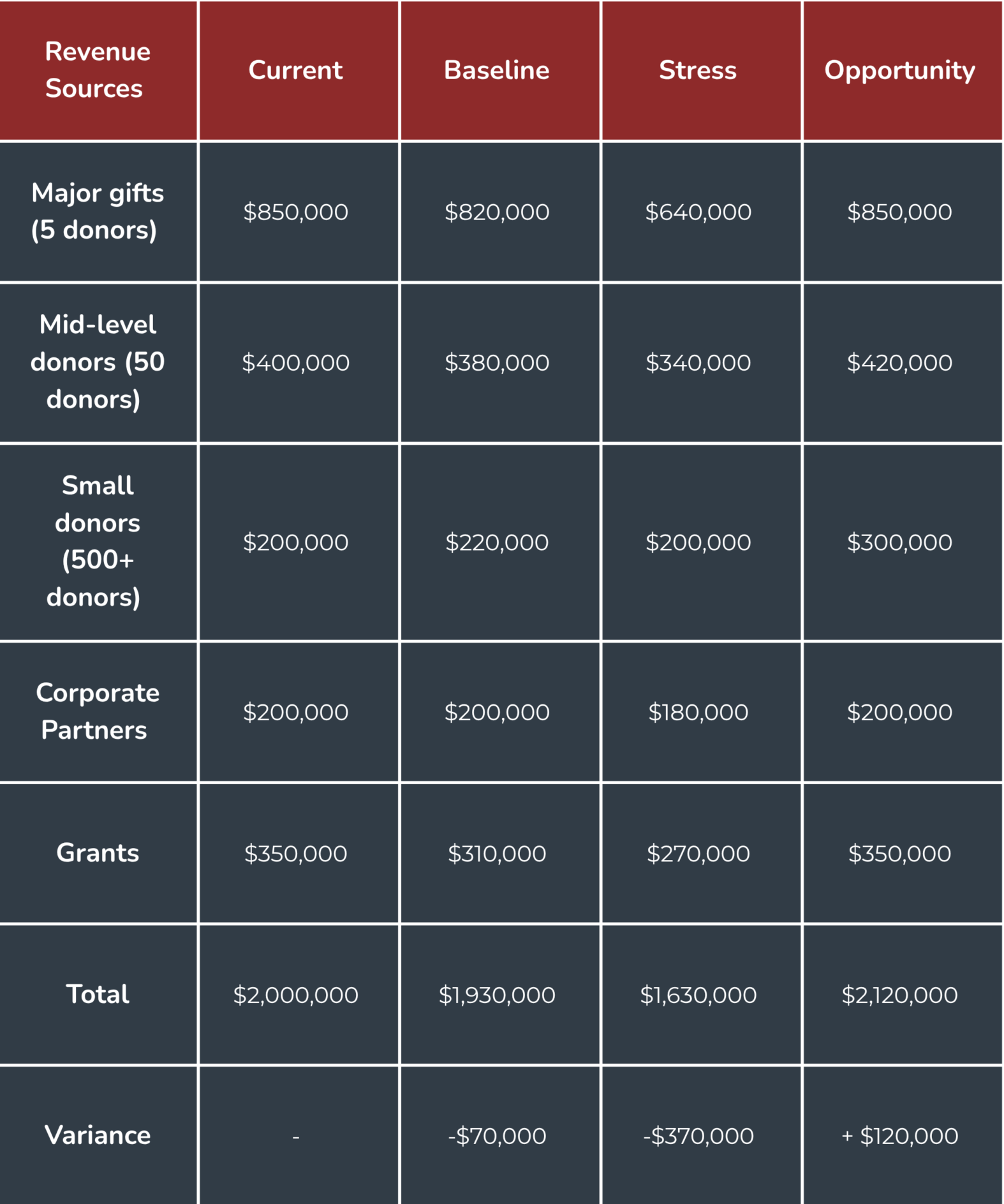
After running your scenarios, update your financial forecasts. If your recent budget wasn’t built with these policies in mind, it’s now a good time to revisit your assumptions. The good thing is you have a starting point; revisit your revenue projections by donor segment, stress-test your key assumptions, and make sure leadership has a current, honest picture of where the organization stands.
Your goal isn’t to predict what’s going to happen, but to be ready when it does.
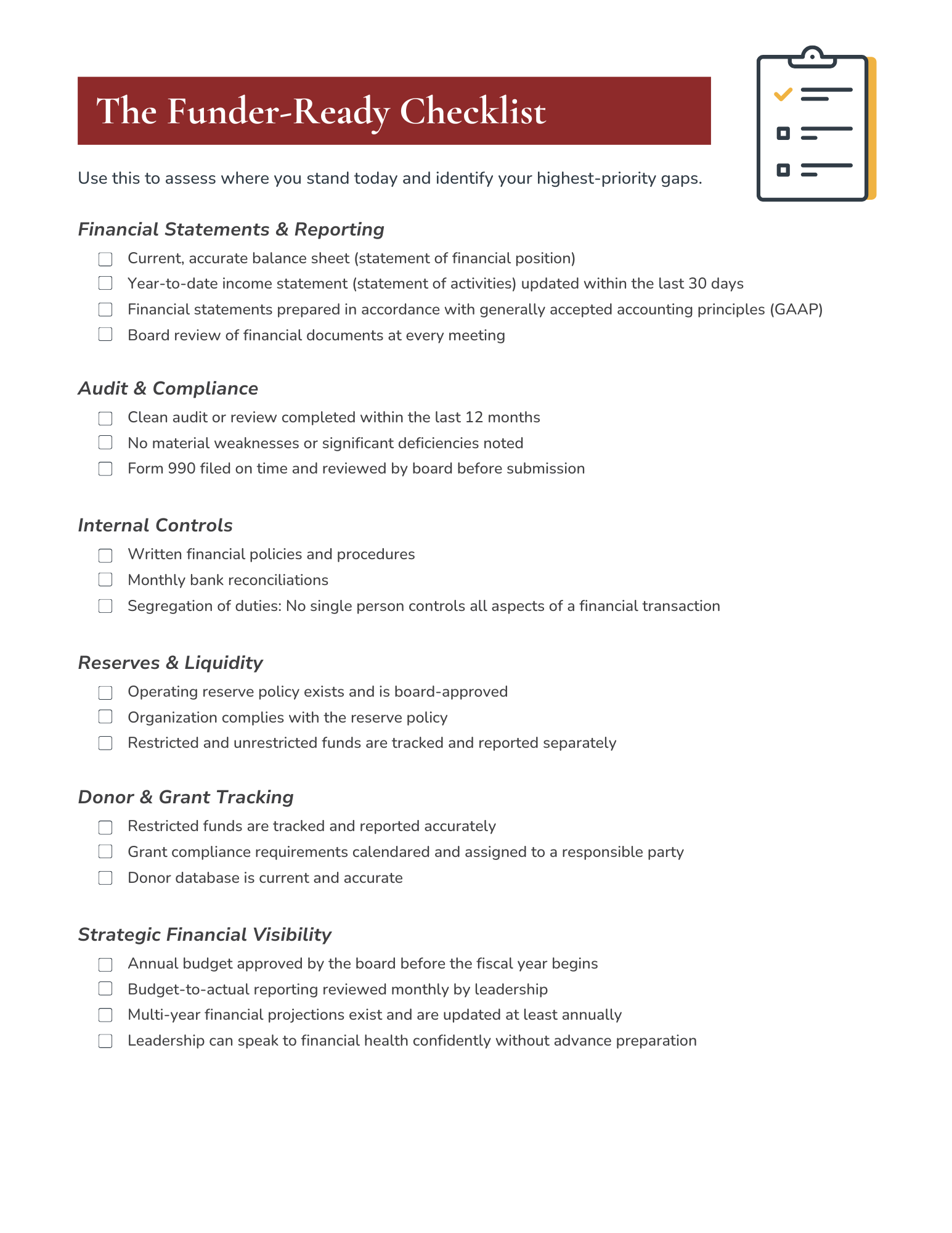
Strengthen the Financial Foundation Funders Look For
When donors have fewer dollars to give and more organizations competing, they get selective. Mission, trust, and financial stewardship become the tiebreakers.
Clear, documented internal controls, clean audits, timely reports, and overall transparent financial data are a few of the criteria funders will use to decide who makes the short list.
And if you aren’t leveraging your Form 990, now’s the time to start. Leaders who view 990s as “just a tax form” are losing the opportunity to use this as a trust-building tool. Major donors and foundations will often pull your Form 990 to determine financial health and mission alignment.
Not funder-ready today? That’s the place to start. In this environment, messy books aren’t just an internal problem. They’re a fundraising one.

Use This Moment to Engage Your Board Strategically
Your nonprofit board can open doors, make introductions, secure funds, and shift donor conversations, but only if they understand what’s at stake right now. Without a clear picture of the current landscape or current numbers, the strategic conversations that this moment requires won’t happen. To start, work through these questions with your board:
- What are we asking donors to support right now?
- What role do you want to play in fundraising?
- How will we measure success as a team?
Without clear answers to “Why now?” and “Why this?”, your board members may struggle to honestly advocate your mission’s needs with their contacts and relationships.
From there, shift the agenda from routine updates to future-focused strategies. Economic headwinds, risks, and opportunities should be the meeting’s main focus. Questions centered on “What’s coming?” and “What can we do?” will sharpen your organization’s direction, help prioritize the resources you do have, and foster board alignment on goals.
A board that is aligned and actively engaging is a competitive advantage; leverage it.
The Leaders Who Will Navigate Well
The organizations that will come out of this strongest aren’t necessarily the largest or the best-funded. They’re the ones who treat finance as a strategic function, not a back-office obligation, and harness it to make faster, more confident decisions.
The years ahead will favor nonprofits with clear financial visibility, donor data they can act on, and leadership that knows what the numbers mean and acts on them.
The giving landscape is changing. Some of those changes will create real pressure. Some will create real opportunities. The leaders who know their numbers, understand their donors, and have the systems in place to plan ahead will be the ones who keep the mission moving.
Build Something Stronger
The organizations that navigate this well won’t be the ones that waited to see what happened. They’ll be the ones that looked honestly at their numbers, understood their exposure, and took action early.
If you’re ready to do that work, we’re here to help. We work exclusively with nonprofits to build the financial foundations that make resilience possible, for anything that comes next.

Share This Post:

Chazin
With over 20 years working exclusively with nonprofits, we pride ourselves in having a unique understanding of nonprofit accounting needs. We believe that nonprofits deserve personalized, quality service and should not settle for a one-size-fits-all approach. We collaborate with you to provide a fully virtual and customized solution that is not only cost-effective but also strengthens your accounting function. We offer a team of industry experts at your disposal to provide advice, leading technology, and to supplement existing staff to improve efficiency and compliance.